Navratri, the festival of nine nights, is celebrated all over India with deep devotion and rich traditions. Each day of Navratri is dedicated to one of the nine forms of Goddess Durga, together known as the Navadurga. These forms represent different parts of Shakti (divine feminine energy) such as strength, wisdom, courage, and compassion.
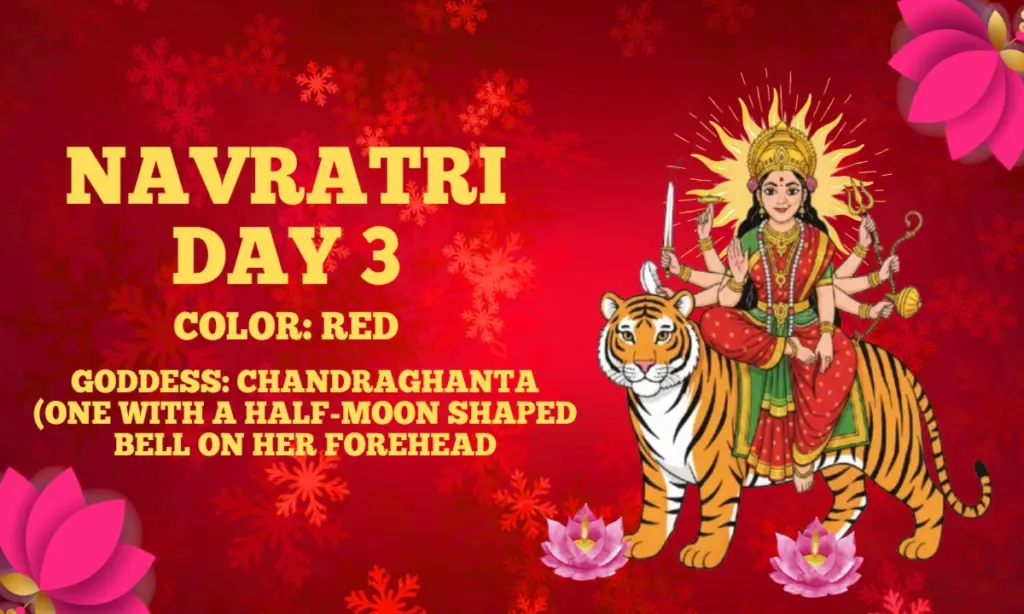
On the third day of Navratri, devotees worship Goddess Chandraghanta, the third form of Maa Durga. She is known as the goddess of bravery, grace, and serenity. The name Chandraghanta comes from the curved, moon-shaped bell (ghanta) that sits on her forehead. Her worship is believed to remove obstacles, drive away negative energies, and instill fearlessness in the hearts of devotees.
Who is Goddess Chandraghanta?
The name “Chandraghanta” is formed by two words:
- Chandra – Moon
- Ghanta – Bell
Thus, Chandraghanta means “the one with a half-moon shaped bell on her forehead.”
She is the married form of Goddess Parvati after her union with Lord Shiva. While Shailaputri represents innocence and devotion, and Brahmacharini symbolizes penance and discipline, Chandraghanta shows courage, power, and protection. She is the warrior goddess who rides a tiger, ever ready to fight evil and protect her devotees.
Iconography of Chandraghanta
In scriptures and images, Goddess Chandraghanta is shown as:
- Riding a fierce tiger or lion, symbolizing bravery and fearlessness.
- Having ten arms, each holding different weapons such as trident, mace, sword, bow, arrow, and kamandalu, while one hand blesses devotees.
- Wearing a golden complexion that radiates divine brilliance.
- A half-moon shaped bell (ghanta) on her forehead, which gives her the name Chandraghanta.
- Always in a posture that reflects courage and readiness to battle evil forces.
Her form is both calm and terrifying, calm towards her devotees and terrifying towards demons and negative energies.
The Mythological Story of Chandraghanta
The legend of Chandraghanta originates from the marriage of Parvati and Lord Shiva. After being reborn as Parvati (following her previous birth as Sati), she performed intense penance to win Lord Shiva as her husband. Pleased with her devotion, Lord Shiva agreed to marry her.
On the wedding day, Shiva arrived with a strange parade of ghosts, sages, goblins, and wild creatures. His appearance was terrifying, ash on skin, snakes around his neck, and a body covered in tiger skin.
Parvati, in her divine wisdom, transformed herself into the powerful form of Chandraghanta. She appealed to Shiva to appear in a more gracious and divine form that suits the marriage ceremony. Lord Shiva agreed, and then their marriage took place in a grand and sacred manner.
From then on, Parvati was worshipped in her married form as Chandraghanta, symbolizing courage, harmony, and marital bliss.
This story shows:
- Balance of Power and Grace – Strength must be balanced with compassion.
- Overcoming Fear – Faith and courage can transform even terrifying situations.
- Sacred Union – The divine marriage of Shiva and Parvati represents balance between masculine and feminine energies.
Spiritual Significance of Day 3 – Worship of Chandraghanta
Worshipping Goddess Chandraghanta on the third day of Navratri is deeply symbolic.
- Bravery and Protection – She protects devotees from negative energies, obstacles, and fears.
- Balance of Life – Her form teaches the balance between courage and calmness.
- Inner Strength – Worshipping her gives confidence and determination in life.
- Peaceful Energy – While she is fierce towards demons, her blessings bring peace and harmony to devotees.
- Spiritual Progress – She helps devotees connect with the Manipura Chakra (Solar Plexus Chakra), associated with willpower and transformation.
Astrological Connection of Chandraghanta
Goddess Chandraghanta is associated with the planet Venus (Shukra) in Vedic astrology. Venus signifies love, beauty, harmony, and material comfort.
- Worshipping Chandraghanta helps reduce the negative effects of Venus.
- She blesses devotees with love, marital harmony, and prosperity.
- Those facing relationship issues, financial troubles, or lack of peace at home seek her blessings for balance and joy.
Day 3 Rituals and Puja Vidhi
On the third day of Navratri, devotees perform Chandraghanta Puja with devotion and discipline.
1. Morning Preparation
- Wake up early, take a holy bath, and wear clean clothes.
- The color of Day 3 is White, symbolizing purity, peace, and calmness.
2. Ghatasthapana Continuation
The Kalash established on Day 1 is still worshipped along with Goddess Chandraghanta.
3. Invocation of Goddess Chandraghanta
- Offer flowers, incense, kumkum, and sandalwood.
- Decorate her idol or picture with white or yellow flowers.
4. Naivedya (Offerings)
- Milk and milk products such as kheer are considered holy offerings to Goddess Chandraghanta.
- Devotees believe it brings peace, prosperity, and relief from worldly sorrows.
5. Fasting (Vrat)
- Many devotees observe a fast, consuming fruits, milk, and satvik food.
- The fast is observed with the intention of self-control and devotion.
6. Mantra Chanting
Devotees chant mantras to invoke her blessings.
Beej Mantra:
“ॐ देवी चन्द्रघण्टायै नमः॥”
(Om Devi Chandraghantayai Namah)
Dhyana Mantra:
पिण्डजप्रवरारूढा चण्डकोपास्त्रकेर्युता ।
प्रसादं तनुते मह्यं चन्द्रघण्टा यशस्विनी ॥
Meaning: I meditate upon Goddess Chandraghanta, who rides a tiger, armed with weapons, who removes obstacles, and who blesses her devotees with fame and success.
Chanting these mantras with devotion is believed to destroy negative energies and fill life with peace and prosperity.
Symbolism of Chandraghanta’s Form
Each element of Chandraghanta’s form holds symbolic meaning:
- Tiger/Lion – Fearlessness and strength.
- Weapons in Ten Hands – Readiness to protect devotees and destroy evil.
- Golden Complexion – Prosperity and divine brilliance.
- Half-Moon Bell on Forehead – Courage that drives away fear and negativity.
- Blessing Hand – Assurance of peace and prosperity to devotees.
Together, her form reminds devotees to be courageous in life while maintaining inner peace.
Benefits of Worshipping Chandraghanta
Devotees believe that worshipping Goddess Chandraghanta on Day 3 of Navratri brings multiple blessings:
- Courage and Fearlessness – Helps overcome challenges and fears.
- Peace and Prosperity – Brings harmony and removes obstacles from life.
- Spiritual Strength – Enhances meditation and inner confidence.
- Marital Bliss – Strengthens love and harmony in relationships.
- Success and Fame – Blesses devotees with recognition and prosperity.
Importance in Indian Households
In Indian culture, the worship of Chandraghanta is seen as a way to bring peace and prosperity into homes. Families light diyas, decorate their houses with flowers, and chant mantras together.
On this day, communities also organize Garba and Dandiya nights, where devotees celebrate with songs, dances, and prayers, calling the protective energy of the Goddess. For many households, Day 3 marks the strengthening of faith, courage, and family bonds.
Conclusion
Day 3 of Navratri is dedicated to Goddess Chandraghanta, the warrior goddess who rides a tiger and bears a half-moon bell on her forehead. She symbolizes courage, grace, and protection. Her worship fills devotees with the strength to overcome fear, obstacles, and negativity while blessing them with peace and prosperity.
Just as the Manipura Chakra is the center of willpower, worshipping Chandraghanta awakens inner strength and determination. Her blessings guide devotees to balance strength with peace, making her worship on this day both spiritually and culturally significant.