

1. Introduction: The Light of Truth and Peace
Guru Nanak Dev Ji is known all over the world as the founder of Sikhism and the first of the ten Sikh Gurus. His life was filled with truth, peace, and devotion to God. He came at a time when people were divided by religion and caste. Guru Nanak taught that everyone is equal and that we can find God through love and good deeds.
His message was not only for Sikhs but for all humanity. He showed that real religion means living with kindness, helping others, and staying truthful in every situation. Guru Nanak’s life was a journey of awakening, spreading light wherever he went.
This biography will take you through the beautiful story of his entire life, from his birth and childhood to his travels, teachings, and the legacy he left behind for the whole world.
2. Birth and Early Life of Guru Nanak Dev Ji

2.1. Birth and Family Background
Guru Nanak Dev Ji was born on 15 April 1469 in a small village called Talwandi, now known as Nankana Sahib in present-day Pakistan. His father, Mehta Kalu Ji, was an accountant in the service of the local ruler, and his mother, Mata Tripta Ji, was a gentle and loving woman.
From the moment of his birth, people around him noticed something special. His calm nature and bright eyes made everyone feel peace and comfort. Many believed he was born with a divine purpose.
His sister, Bebe Nanaki, was the first to recognize his spiritual nature. She loved him deeply and always supported him. Later, Guru Nanak also stayed with her during his early years, and she continued to encourage his spiritual growth.
2.2. Childhood and Education
As a child, Guru Nanak was very intelligent and curious. He always asked deep questions about life and God. When he went to school, his teacher gave him letters and numbers to learn. But young Nanak used them to explain spiritual meanings.
For example, he said that every number represents a truth of life, showing how God’s creation works in harmony. His teacher was amazed by his understanding and realized that Nanak’s wisdom was far beyond his age.
He did not care much about material things or games like other children. Instead, he enjoyed thinking deeply and helping others.
2.3. Love for Nature and Meditation
Guru Nanak often spent hours near the river or under trees, watching the sky, birds, and plants. He felt that nature was a reflection of God’s beauty. The sound of flowing water and the songs of birds made him feel close to the Creator.
He began to meditate at a very young age. Through meditation, he understood that God is one and lives in everyone. This connection with nature became an important part of his spiritual path later in life.
3. Early Signs of Spiritual Awakening
3.1. Kindness and Equality
Guru Nanak always showed kindness toward people and animals. He helped those who were poor or sick, and he treated everyone with respect. He never believed in the idea that some people are high or low because of their birth or religion.
One famous story from his youth shows his pure heart. His father gave him twenty rupees and asked him to do a good business. On his way, he saw hungry people sitting on the roadside. Instead of buying goods to sell, he used the money to buy food for them.
When his father asked what he had done, Guru Nanak said that helping the hungry was the best trade. He called it Sacha Sauda, which means true business. This simple act became a symbol of his message, that serving humanity is the real path to God.
3.2. Marriage and Family Life
At the age of 18, Guru Nanak married Mata Sulakhni Ji in 1487. She was a kind-hearted woman who understood his spiritual nature. They had two sons, Sri Chand and Lakhmi Chand.
Even after marriage, Guru Nanak lived a simple and spiritual life. He worked as a storekeeper in Sultanpur Lodhi for a while, earning honestly and sharing his income with those in need. He showed that a person can live a family life and still stay close to God if they live truthfully and do good deeds.
3.3. A Peaceful Worker and Thinker
During his time in Sultanpur, Guru Nanak worked under a Muslim employer named Daulat Khan. He was respected by everyone for his honesty and calm nature. Every morning and evening, he would meditate on God’s name.
People who met him often felt peace in their hearts. He was always gentle, never angry, and believed that good thoughts bring good actions.
4. The Moment of Enlightenment
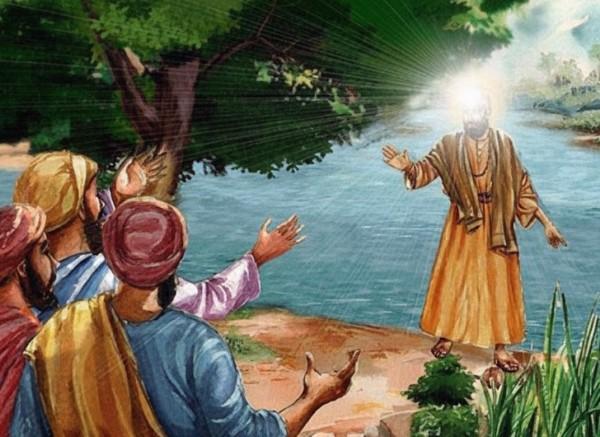
One morning, as usual, Guru Nanak went to the river Bain near Sultanpur for his daily meditation. He entered the water and did not return for three days. Everyone in the village thought he had drowned. His family and friends searched for him everywhere but could not find him.
After three days, he came back glowing with peace and calmness. When people asked what had happened, he said he had been in the presence of God and received His message. The first words he spoke were:
“There is no Hindu, there is no Muslim.”
By this, he did not mean to deny religions but to show that all people are equal before the same God. He explained that true religion is to live with love, truth, and kindness, not to fight in the name of faith.
From that day, Guru Nanak began his mission to teach people about oneness, honesty, and compassion. He started to sing hymns that praised the beauty of God and the importance of good deeds.
5. Teachings and Philosophy of Guru Nanak Dev Ji
Guru Nanak’s teachings are very simple and practical. He said that God is one and that we can feel His presence everywhere, in nature, in people, and in our hearts. He encouraged people to live a good life filled with honesty and service.
5.1. The Three Core Principles
Guru Nanak gave three main principles for a happy and meaningful life:
- Naam Japna – Remember God’s name at all times and keep your mind pure.
- Kirat Karni – Work hard and earn your living honestly, without cheating anyone.
- Vand Chakna – Share what you earn with others, especially the poor and needy.
These three ideas form the base of Sikhism and are still followed by millions of people around the world.
5.2. Equality, Truth, and Justice
Guru Nanak rejected all forms of inequality because he believed that every person, no matter their caste or religion, carries the same divine light within. He strongly opposed injustice and the unfair treatment of women.
He said, “Why call her inferior, when she gives birth to kings?”
This showed his deep respect for women and his belief in equality for all.
5.3. Simple Way of Worship
For Guru Nanak, real worship was not about performing rituals or visiting temples. He believed that the best prayer is to live a life full of love and truth.
He encouraged people to do good deeds, speak kind words, and meditate on God’s name. According to him, a person’s heart is the real temple, and service to others is the highest form of devotion.
6. Guru Nanak’s Four Great Journeys (Udasis)
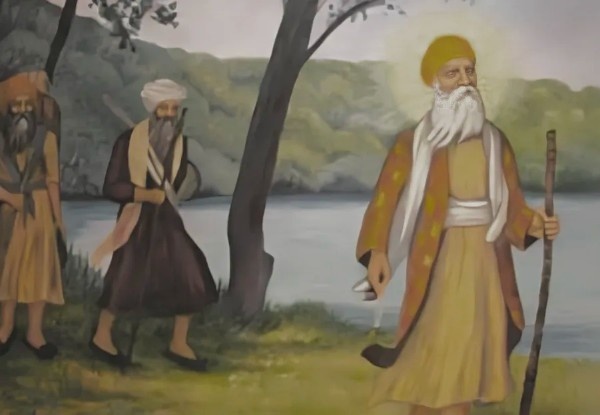
After enlightenment, Guru Nanak started traveling to spread the message of peace and unity. These journeys are called Udasis. They lasted for nearly 20 years, and he visited many countries and holy places.
He traveled with his companion Bhai Mardana, who played the rebab (a string instrument), while Guru Nanak sang hymns filled with divine wisdom.
6.1. First Udasi (Eastward Journey)
His first journey was toward the eastern part of India. He visited Haridwar, Banaras, Gaya, Kamrup (Assam), and Bengal.
At Haridwar, he saw people throwing water toward the rising sun to honor their ancestors. Guru Nanak started throwing water in the opposite direction. When the priests asked him why, he said he was watering his fields in Punjab. They laughed, but he gently explained that if water can reach the ancestors in heaven, then why can it not reach his distant fields?
This small action taught that rituals without understanding have no real value. True devotion is about good actions, not blind customs.
6.2. Second Udasi (Southward Journey)
Guru Nanak’s second journey was toward the south of India. He traveled through Andhra Pradesh, Tamil Nadu, and Sri Lanka.
He met saints, scholars, and local people of different faiths. Everywhere he went, he sang hymns and shared his message that God is one and beyond any form or name. He said that all religions lead to the same truth if people follow love and honesty.
During these travels, he built friendships across cultures and showed that peace can exist when people see God in everyone.
6.3. Third Udasi (Northward Journey)
Guru Nanak Dev Ji’s third journey took him toward the northern regions. He visited places like Kashmir, Tibet, and the Himalayas. The purpose of these travels was to share his message with saints, yogis, and spiritual seekers who lived in the mountains.
In the Himalayas, he met many people who believed that the only way to reach God was through hard meditation and isolation from the world. Guru Nanak gently explained that real spirituality is not about leaving the world but living truthfully within it.
He said that one can be close to God even while living a family life, doing honest work, and helping others. He taught that serving people is equal to serving God. His kind words and peaceful nature inspired everyone he met.
In these regions, he also sang hymns about the beauty of nature and the greatness of the Creator. His songs reminded people that the mountains, rivers, and sky all reflect the divine presence.
6.4. Fourth Udasi (Westward Journey)
The fourth and last major journey of Guru Nanak Dev Ji was toward the west. He visited many countries like Afghanistan, Iran, Iraq, and even reached Mecca and Medina.
At Mecca, he lay down to rest with his feet facing the Kaaba, the holy place of Muslims. A caretaker angrily told him to move his feet away from the Kaaba. Guru Nanak calmly replied, “Please turn my feet in the direction where God is not.”
When the man tried to move his feet, he felt that wherever he turned them, the Kaaba appeared. He was surprised and understood Guru Nanak’s message, that God is everywhere.
During this journey, Guru Nanak met many spiritual people of different faiths. He never tried to change anyone’s religion. Instead, he encouraged everyone to live a life of truth and remember the one Creator.
These long journeys helped spread his teachings far and wide. People of all backgrounds began to see him as a messenger of peace and unity.
7. Return to Punjab and Founding of Kartarpur
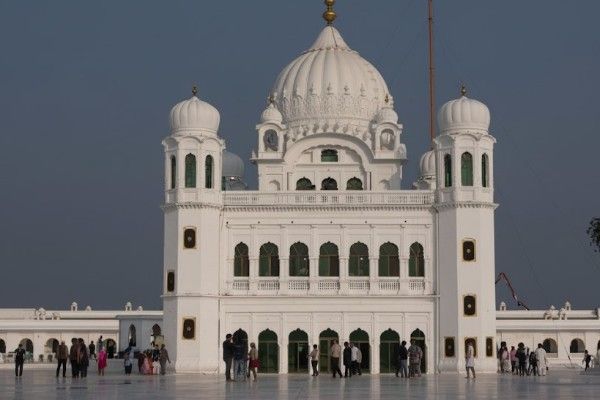
After traveling for nearly two decades, Guru Nanak returned to Punjab. By this time, he was respected and loved across many lands. People from different religions followed his teachings.
Guru Nanak chose to settle down in a place near the river Ravi and founded a small town called Kartarpur. The word Kartarpur means “The City of the Creator.”
In Kartarpur, he started a simple community life based on equality, hard work, and prayer. Every day, people gathered to sing hymns, meditate, and share food in the langar, a free community kitchen started by Guru Nanak himself.
The langar became a symbol of equality. Everyone, rich or poor, Hindu or Muslim, sat together and ate the same food. It showed that all humans are equal in the eyes of God.
Guru Nanak also worked in the fields with others and lived a very humble life. He showed that spirituality is not separate from daily life. Hard work, truth, and service are the real ways to live close to God.
8. Final Years and Teachings
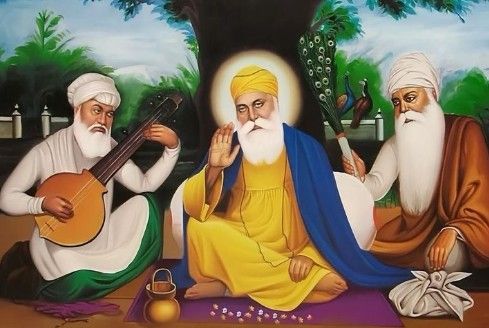
Guru Nanak Dev Ji spent his final years in Kartarpur guiding his followers and spreading his message. By then, many people had become his disciples and lived by his teachings.
He taught that true religion is not found in books or temples but in the way we live and treat others. He said that kindness, truth, and honesty are the keys to peace.
8.1. Selection of Successor
As his time on earth was coming to an end, Guru Nanak decided to choose a successor to continue his mission. He selected Bhai Lehna Ji, a devoted follower, and gave him the name Guru Angad Dev Ji. This marked the beginning of the Sikh Guru tradition.
Guru Nanak’s decision showed his humility and wisdom. He did not choose his own sons, showing that leadership is based on devotion, not family ties.
8.2. The Final Message
In 1539, Guru Nanak Dev Ji left his physical body in Kartarpur. Before leaving, he reminded his followers that God is eternal and that truth will always guide the soul.
A beautiful story says that after his passing, Hindus and Muslims argued about how to perform his last rites. When they lifted the cloth covering his body, they found only flowers instead. Each group took half of the flowers and performed their rituals peacefully.
This event symbolized his final teaching, that there is no difference between people when their hearts are filled with love and respect.
9. Legacy of Guru Nanak Dev Ji
Guru Nanak’s teachings became the foundation of Sikhism, a faith built on truth, equality, and service to humanity. His followers, called Sikhs, continue to live by his words.
9.1. His Eternal Message
Guru Nanak’s message can be summed up in a few simple but powerful ideas:
- God is One and lives in all.
- All humans are equal.
- Speak the truth and do honest work.
- Share with others and help the needy.
- Live peacefully and avoid pride or greed.
His teachings are collected in the Guru Granth Sahib, the holy book of Sikhs, which also includes writings of other saints who shared his vision of peace and unity.
9.2. Inspiration Across the World
Even today, people from all religions respect Guru Nanak Dev Ji. His birthday, known as Guru Nanak Jayanti or Guruparv, is celebrated with devotion all over the world.
On this day, processions, prayers, and community meals remind everyone of his message of equality and kindness. Gurdwaras are decorated beautifully, and people gather to sing hymns and remember his teachings.
His life continues to inspire people to live with compassion and truth in every action.
10. Lessons from Guru Nanak’s Life for Today’s World
Guru Nanak Dev Ji’s words are timeless. Even in today’s fast and busy world, they offer deep lessons for everyone.
- Respect all religions and people – Every person carries the same divine light.
- Live truthfully – Honesty brings peace to the heart.
- Serve others selflessly – Helping others is the highest form of worship.
- Stay humble – Ego separates us from God.
- Remember God in daily life – Meditation and gratitude bring calmness and happiness.
These simple principles can make our world more peaceful if everyone follows them with an open heart.
Conclusion
The life of Guru Nanak Dev Ji is a beautiful example of truth, love, and unity. From his childhood curiosity to his great journeys, every part of his life was guided by the light of God.
He lived among people, worked honestly, shared with others, and showed that kindness is the true path to spirituality. His teachings are not limited to one religion but belong to all humanity.
Guru Nanak Dev Ji’s message reminds us that we do not need wealth or power to find peace, we only need truth, humility, and love for all.
Even after more than 500 years, his words still shine like a lamp that guides people toward goodness and wisdom.
FAQs
Q1. When and where was Guru Nanak Dev Ji born?
Guru Nanak Dev Ji was born on 15 April 1469 in Talwandi, which is now called Nankana Sahib, in Pakistan.
Q2. What are the main teachings of Guru Nanak Dev Ji?
He taught three main principles, which are Naam Japna (remembering God), Kirat Karni (earning honestly), and Vand Chakna (sharing with others).
Q3. How many Udasis or journeys did Guru Nanak undertake?
Guru Nanak Dev Ji went on four major journeys, called Udasis, to spread the message of peace and equality.
Q4. Where did Guru Nanak Dev Ji spend his final years?
He spent his final years in Kartarpur, a town he founded near the river Ravi.
Q5. What is the message of Guru Nanak’s life for today’s world?
Guru Nanak teaches us to live truthfully, help others, stay humble, and see God in every living being.