Navratri is one of the most holy Hindu festivals, which celebrates the nine forms of Goddess Durga, known as Navadurga. Each day of Navratri is dedicated to one form of the Goddess, representing different parts of divine feminine power. These forms guide devotees on a spiritual journey that moves from grounding and strength to wisdom and ultimate liberation.
On the second day of Navratri, people worship Goddess Brahmacharini. She is seen as the symbol of penance, self-control, and devotion. She represents patience, a simple way of living, and the pursuit of knowledge and wisdom. Her worship is believed to bless devotees with peace, patience, and success on the spiritual as well as material path.
Who is Goddess Brahmacharini?
The word “Brahmacharini” comes from two Sanskrit terms:
- Brahma – supreme knowledge or penance
- Charini – one who practices or follows
Thus, Brahmacharini means the one who practices the highest form of penance and devotion.
She is considered as a form of Goddess Parvati, who lived a life of strict discipline and hard penance to win Lord Shiva as her husband.
Iconography of Brahmacharini:
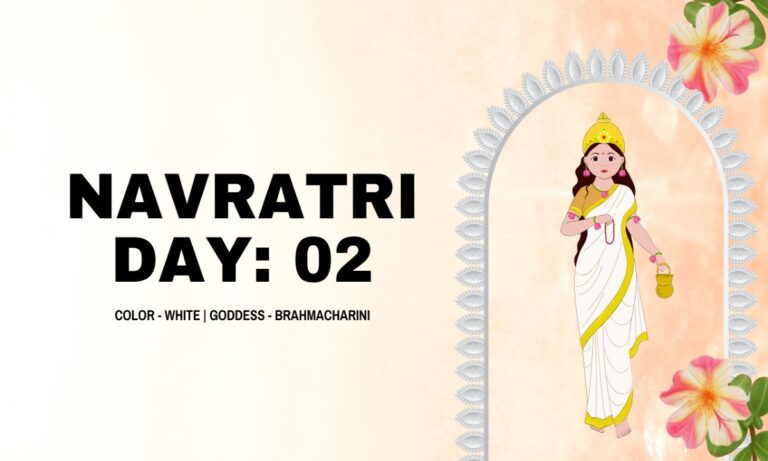
In pictures and idols, Brahmacharini is shown as a calm and simple Goddess:
- She walks barefoot, symbolizing being down to earth and detachment.
- She holds a japa mala (rosary) in her right hand, representing meditation and devotion.
- She carries a kamandalu (water pot) in her left hand, a symbol of simplicity and spiritual life.
- She wears plain white clothes, radiating purity, peace, and discipline.
Unlike the fierce forms of Durga, Brahmacharini reflects calmness, inner strength, and spiritual resolve.
The Mythological Story of Brahmacharini
According to mythology, in her previous birth as Sati, the Goddess burned herself due to her father Daksha’s insult to Lord Shiva. Later, she was reborn as Parvati, the daughter of King Himavan. From childhood, she was deeply devoted to Lord Shiva and desired to marry him.
To win Lord Shiva, Parvati lived a simple and strict life and performed intense penance. For thousands of years, she survived only on fruits, later only on leaves, and eventually gave up even water and food. Her severe tapasya (penance) impressed the gods, sages, and Lord Shiva himself. Finally, Lord Shiva accepted her as his wife.
This form of Parvati came to be known as Brahmacharini, symbolizing determination, patience, and devotion in the path of spirituality.
Lessons from Her Story:
- Devotion requires patience and perseverance.
- Discipline and self-control lead to success.
- Faith and dedication can overcome any challenge.
Spiritual Importance of Day 2 – Worship of Brahmacharini
Day 2 of Navratri is deeply symbolic, as it represents devotion, penance, and spiritual growth.
- Tapasya (Penance): Brahmacharini reminds us that success comes through hard work, patience, and inner strength.
- Control of Desires: She inspires devotees to rise above worldly attachments and remain focused on higher goals.
- Muladhara to Swadhisthana Chakra Transition: While Shailaputri governs the root chakra, Brahmacharini activates the Swadhisthana (sacral) chakra, associated with creativity, emotions, and discipline.
- Peace and Positivity: Her worship helps devotees cultivate inner peace, reduce stress, and strengthen emotional stability.
Astrological Connection of Brahmacharini
Brahmacharini is associated with the planet Mars (Mangal) in Vedic astrology.
- Mars represents energy, discipline, and strength.
- People believe that worshipping Brahmacharini can reduce the bad effects of Mars in a person’s horoscope.
- Devotees facing obstacles, anger issues, or instability are advised to worship her for balance and courage.
Day 2 Rituals and Puja Vidhi
On the second day of Navratri, devotees observe special rituals dedicated to Brahmacharini.
1. Morning Preparation
- Devotees wake up early, take a bath, and wear white clothes (the color of the day).
- The puja altar is decorated with flowers, especially jasmine and white blooms.
2. Kalash Puja & Invocation
- The Kalash placed on Day 1 (Ghatasthapana) continues to be worshipped.
- A picture or idol of Brahmacharini is placed, decorated with flower strings.
3. Offerings (Naivedya)
- Sugar and fruits are offered as prasad.
- Offering sugar to the Goddess is believed to bring sweetness and peace in life.
4. Fasting (Vrat)
- Many devotees observe fasts by consuming fruits, milk, or simple satvik (vegetarian) food.
- Fasting is believed to purify the body and mind, enhancing concentration and devotion.
5. Lighting the Lamp & Mantra Chanting
- A ghee lamp is lit during the puja.
- Devotees sincerely chant her mantras to receive her blessings.
Mantras of Goddess Brahmacharini
Beej Mantra
“ॐ देवी ब्रह्मचारिण्यै नमः॥”
(Om Devi Brahmacharinyai Namah)
Dhyana Mantra (Meditation Verse)
दधाना करपद्माभ्यामक्ष्मालकमण्डलु ।
देवी प्रसीदतु मयि ब्रह्मचारिण्यनुत्तमा ॥
Meaning: I bow to Goddess Brahmacharini, who holds a rosary and a water pot, symbolizing devotion and penance. May she bless me with peace, patience, and wisdom.
Chanting these mantras brings calmness, clarity, and success in both worldly and spiritual pursuits.
Color of Day 2 – White
Each day of Navratri has a symbolic color. The color for Day 2 is White.
- White represents purity, peace, and wisdom.
- Devotees wear white clothes to attract the blessings of Brahmacharini.
- The color brings peace, positivity, and a calm mind.
Symbolism of Brahmacharini’s Form
Every part of Goddess Brahmacharini carries deep meaning:
- Bare Feet – down to earth, simplicity, and detachment.
- Rosary (Japa Mala) – Devotion, meditation, and focus on spiritual growth.
- Kamandalu (Water Pot) – sacrifice, purity, and discipline.
- White Clothes – Peace, knowledge, and inner strength.
Together, these symbols remind devotees of the power of patience, perseverance, and faith.
Benefits of Worshipping Brahmacharini
Devotees believe that worshipping Brahmacharini on the second day of Navratri brings several blessings:
- Inner Peace – Reduces stress and anxiety.
- Strength & Patience – Helps overcome life challenges with calmness.
- Harmony in Relationships – Brings sweetness and understanding.
- Success in Studies & Career – Enhances focus, dedication, and discipline.
- Spiritual Progress – Guides devotees toward higher consciousness and devotion.
Importance for Indian Households
Day 2 of Navratri is considered special in Indian households. Families decorate puja spaces with fresh flowers, light diyas, and chant mantras together.
Community celebrations include bhajans, kirtans, and group prayers. Many women observe fasts for the well-being of their family, while students seek the Goddess’s blessings for knowledge and focus.
For devotees, Day 2 sets the tone for discipline, devotion, and spiritual learning throughout Navratri.
Conclusion
Day 2 of Navratri is dedicated to Goddess Brahmacharini, the form of Devi who symbolizes simple living, discipline, and devotion. Her life and penance inspire us to stay determined, overcome challenges, and remain committed to our goals.
Just as she performed severe tapasya to attain Lord Shiva, her worship teaches devotees the importance of patience, self-control, and faith. By praying to her, a person gains peace, wisdom, and strength in life
As Navratri continues, the journey of worshipping Navadurga progresses deeper into spiritual awakening, and with Brahmacharini, devotees embrace discipline, knowledge, and purity of the soul.